
.jpg)
Three months with the Ricoh GRiii
- Petr Svitil
- Sep 16, 2021
- 5 min read

Updated: Apr 24, 2023
I have had the Ricoh GRiii for about three months now and I think that is enough time to get a general sense of how it performs. So let’s get into why I bought it, what was my expectation, and whether it was met by this marvelous piece of equipment.
To start out, these were my requirements:
The price needed to be affordable, so under 1,000USD
I needed something pocketable which I could comfortably take with me anywhere.
The image quality needed to be better than the average smartphone
The camera needed to have a relatively fast lens and big enough sensor in order to create bokeh and take images in the evenings in lower light conditions
Something that would spark my curiosity and push me out of my comfort zone of portrait photography
I purchased a new GRiii for about 800 USD in May 2021. This is the regular price in the US but in Europe the price was around 1,100 USD, making the discount a deciding factor.
Next the camera needed to fit into my kidney bag, one of those that became popular during 2021 and were worn across the chest. The idea was to always have a camera available to document what I see, and be able to capture either the equivalent of a modern day Hindenburg disaster or just of a proverbial passing cat (or dog if you will).


To give an example, during my stay in Korea in 2018, my friends and I decided to go hike to the highest mountain in Seoul. It was an amazing experience and the view from the top was even more so. Except that I didn’t bring my camera with me because the only one I had at the time was a large 5Div, and who wants to haul that brick on a hike? So at the top I was not able to produce any images of value.
You might ask, why didn’t I use my phone up there? The answer is because my phone was the Samsung J5 (2017) which had appalling image quality. A friend of mine however managed to capture amazing images there with her MTF camera which didn’t hold her back during the hike, and that’s when I realized that a smaller camera can be preferable to no camera at all (I know.. What a revolutionary idea..).
As someone obsessed with bokeh, I didn’t want to get a MTF camera with a f4 lens though. I wanted a camera that I knew could produce some background separation when desired. The GRiii has a f2.8 lens coupled with an APS-C sensor. This combination is quite impressive given how small the camera is. While you’ll certainly struggle making much if any bokeh when taking wide images of people, if you focus closer it’s definitely possible (especially in the macro mode).
The f2.8 lens also feeds back into the image quality requirement above, as well as the desire to be able to take images in the evenings when light becomes sparse. Of course, it’s not ideal to take images then, but your day doesn’t end when the lights go out. Not always anyways. But an even bigger feature is the 2-stop IBIS. I’ve been able to take good images at 1/30th or even 1/10th and get away with it.
Most importantly, I wanted a new piece of kit that would change how I photograph. I have an EOS RP and 5Div at my disposal as well as a plethora of lenses, but it’s too much and too heavy. How many times do you want to go take photos but can’t be bothered to pack and carry it all? So you never go to take those images you dream about. The GRiii was the solution for me. Yes it has limitations due to being a fixed lens, but you work along and around the limitations.
I believe the 28mm lens is a good choice when you are trying to document your surroundings. It’s not too wide like a 20mm but neither too constraining like a 35mm. Whereas previously I’d be looking for surfaces, walls, and pillars I could pose a model at, now I’m looking at the location as a whole. And sometimes a location isn’t attractive for a portrait shoot, but it looks appealing on it’s own. Certainly, it could be interesting to review those places fifty years later (like in the cases of Vivian Maier and Fan Ho).
Let’s go a step further and talk about filters for the little guy. There is no doubt that when shooting still life filters can dramatically change your image. At the time of writing, NISI has 3 filter kits for the GRiii; the Starter, Pro, and Master kits. Each kit has more filters than the previous and comes with an adapter for the GRiii (also sold separately if you only want to screw the 49mm screw filters. The Master kit contains a 3-stop and 6-stop ND, 2 graduated NDs, and a polarizer. And don’t forget that the GRiii has a built-in 2-stop ND filter so in total you can have a 11-stop combo for the extreme long shots (just don’t forget to switch the built-in ND off when you’re done with it..).


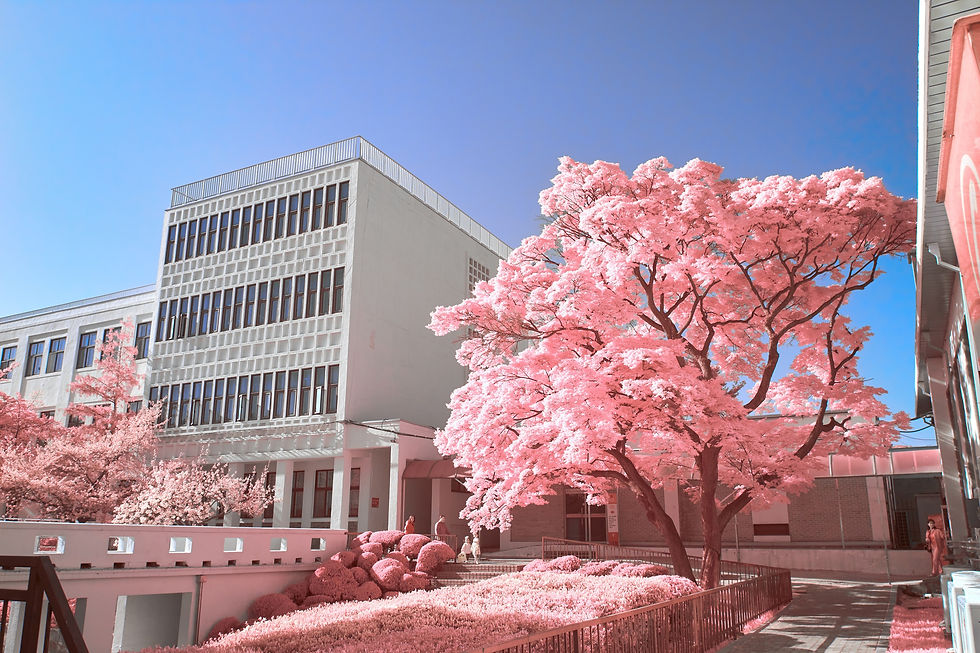
I would like to direct your attention to the ability to screw 49mm filters on the adapter though. I got a R72 infrared filter and got some amazing results, wait for it, hand-held. Yes, you won’t shoot at ISO 100 then, but it’s possible to get decent shots on the go, without a tripod and 10 minutes to set everything up. It takes about a minute to get your GRiii ready to shoot IR on the go, and set up time is what usually discourages us from taking an image in the first place, so let’s eliminate extensive set up time.


I will note that while you can use the ND filters to even further extend the exposition time (to get the clouds smudged for example if there is little wind), be cautious and don’t forget to switch off the internal ND.. The GRiii has a great sensor, but if you push the ISO to 6400 you start to see it (though it is not so bad that the images would be unusable. The other note is that I have not yet figured out how to turn the IR images to color. I was able to do it with images from my EOS RP, but struggle to figure it out with the GRiii, so all my IR images currently are BW (which in some cases seems a shame).
The GRiii has allowed me to take images I previously would not have been able to take. Not because I didn’t have the equipment, but rather because I had too much of it. Too much gear will inadvertently cause us to not want to carry it to a location (much less if there is no guarantee of getting a shot) and bother with the often long and tedious setup. Minimizing your kit and only carrying what you will really need can be relieving and refreshing.


Comments